
COAST-SCAPES at the 19th PLINIUS Conference on Mediterranean Risks
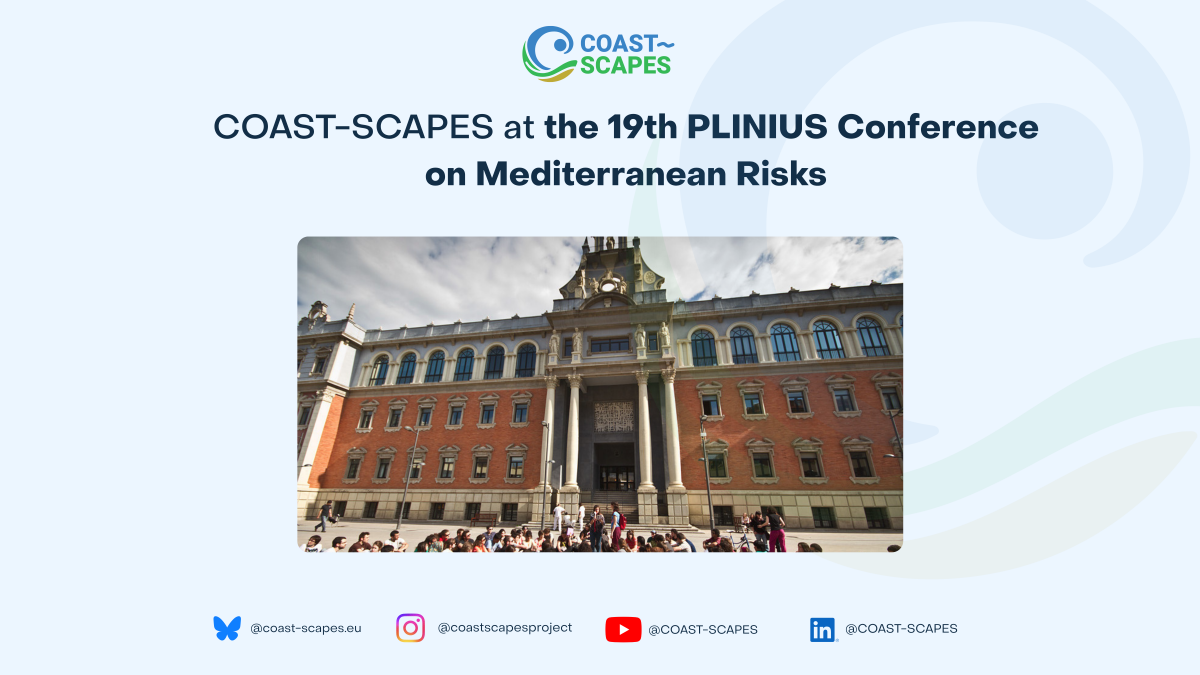
COAST-SCAPES took part in the 19th PLINIUS Conference on Mediterranean Risks, held in Murcia, Spain, from 6 to 9 October 2026. The conference brings together researchers and practitioners working on natural hazards and risks across the Mediterranean region.
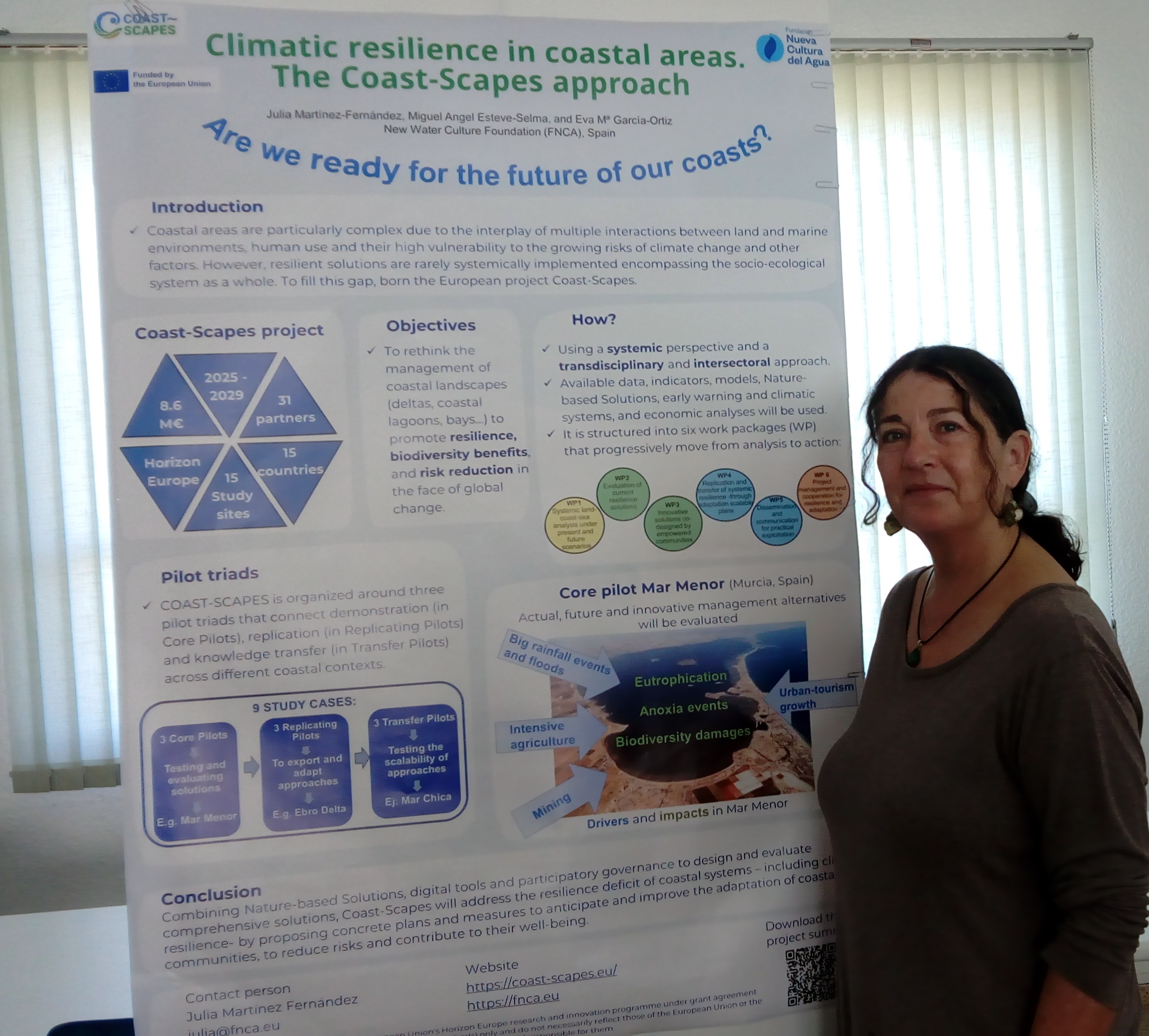
On Thursday, 8 October, the COAST-SCAPES consortium members presented a poster titled “Climatic resilience in coastal areas. The Coastscapes approach” in session PL6, “Impacts of climate change and extremes on ecosystems and agriculture”. The poster was authored by Julia Martínez-Fernández and Eva García-Ortiz of FNCA, a partnering organisation within the project.
 |
The contribution outlined how COAST-SCAPES approaches climate resilience in coastal areas, and it gave the project a chance to exchange ideas with the scientific community working on climate extremes and their impacts on ecosystems and agriculture.
The poster also focuses on the need to address coastal systems through an integrated perspective that connects river basins, lagoons, the coastline, socioeconomic activities, and governance. Coastal zones are particularly complex due to the interplay between continental and marine environments, human activities and their high vulnerability to the mounting risks posed by climate change. In this context, COAST-SCAPES advocates for moving beyond sectoral approaches and, instead, treating coastal landscapes as interconnected socio-ecological systems. The project proposes integrating the entire land-coast-sea system into its analysis, accounting for the relationships between river basins, lagoons and other coastal ecosystems, the marine environment, economic activities, and governance systems.
The poster presented focuses specifically on the Mar Menor and its basin, one of the three core case studies for Coast-Scapes, a territory that serves as a prime example of the complex challenges facing Mediterranean coastal systems. In the Mar Menor, the effects of climate change may interact with existing pressures on the lagoon and its basin. Rising temperatures and specific instances of intense rainfall can promote eutrophication and episodes of anoxia. Furthermore, higher temperatures pose a risk to meadows of the macroalga Caulerpa prolifera; this species is more sensitive to temperature increases than the seagrass *Cymodocea nodosa*, which it had replaced across large areas following the eutrophication crises of 2016, 2019, and 2021. Simultaneously, the increased vulnerability of irrigated crops to drought may heighten reliance on the Tajo-Segura water transfer, desalination or groundwater, all resources already under significant strain from overexploitation and pollution.
The participation of the FNCA in PLINIUS thus provides an opportunity to share the initial concepts and lines of work of Coast-Scapes—specifically the approach being developed for the Mar Menor—with the scientific community specializing in Mediterranean risks.
Find out more about the conference here.
View the session and poster here.


