
A new COAST-SCAPES publication explains coastal dune vulnerability to tropical cyclones in Mozambique
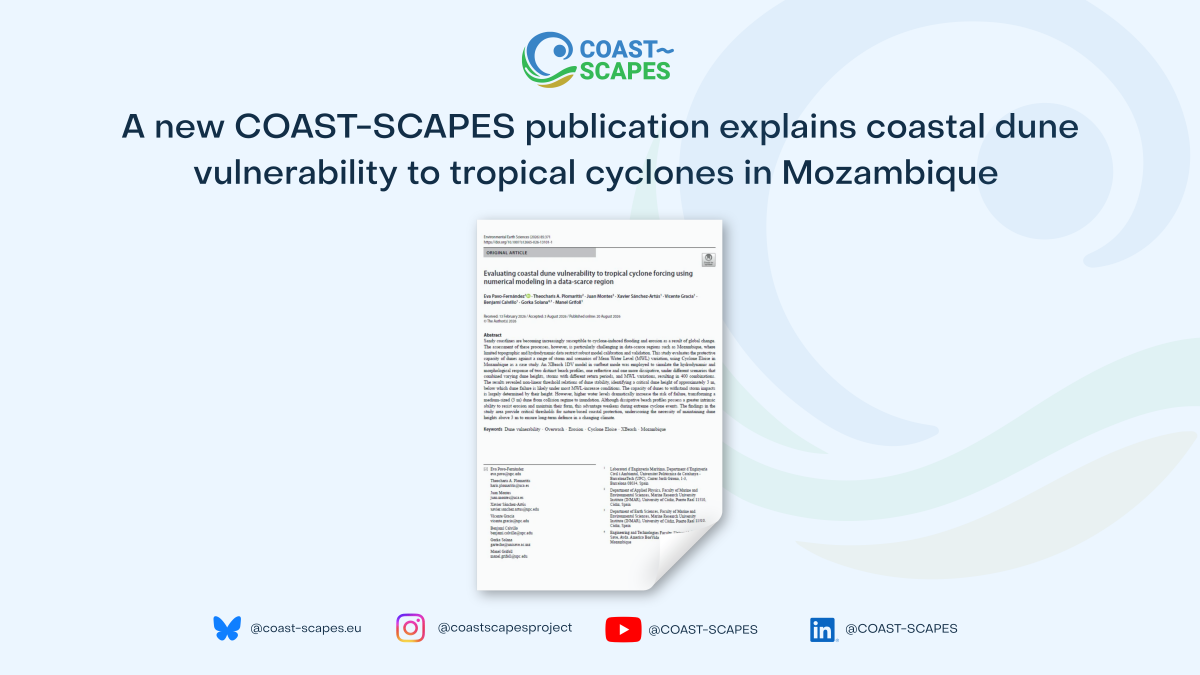
COAST-SCAPES is proud to announce a new scientific publication, titled “Evaluating coastal dune vulnerability to tropical cyclone forcing using numerical modeling in a data-scarce region.” The study is co-authored by project members Eva Pavo-Fernández, Xavier Sánchez-Artús, Vicente Gracia, Gorka Solana & Manel Grifoll and is published open access in the journal Environmental Earth Sciences. The article assesses how well coastal dunes protect sandy shorelines from cyclone-driven flooding and erosion, using cyclone Eloise in Mozambique as a case study. Supported by COAST-SCAPES, this work reflects the project’s commitment to advancing nature-based approaches to coastal protection and resilience under global change.
Sandy coastlines are becoming increasingly exposed to cyclone-induced flooding and erosion, yet assessing these processes is particularly difficult in data-scarce regions like Mozambique, where limited topographic and hydrodynamic data make it hard to calibrate and validate models. To address this, the researchers used the XBeach model to simulate how two contrasting beach profiles, one reflective and one more dissipative, respond to storms. They tested 400 combinations of dune heights, storm return periods and changes in mean water level.
The results show that dune stability follows non-linear threshold relations. A critical dune height of approximately 3 m emerged. And below it, dune failure is likely to increase water level. Dune height largely determines whether a dune can withstand a storm, but higher water levels sharply increase the risk of failure. A medium-sized (3 m) dune can shift from the collision regime to inundation. Dissipative beach profiles are naturally better at resisting erosion and keeping their shape, but this advantage weakens during extreme cyclone events.
To conclude, the study provides critical thresholds for nature-based coastal protection and underlines the need to keep dune heights above 3 m to secure long-term defence in a changing climate. It also shows how process-based modelling can deliver actionable insights for coastal planning in regions where field data are scarce.
Read the full article here.


