
New COAST-SCAPES publication on future changes of coastal extremes
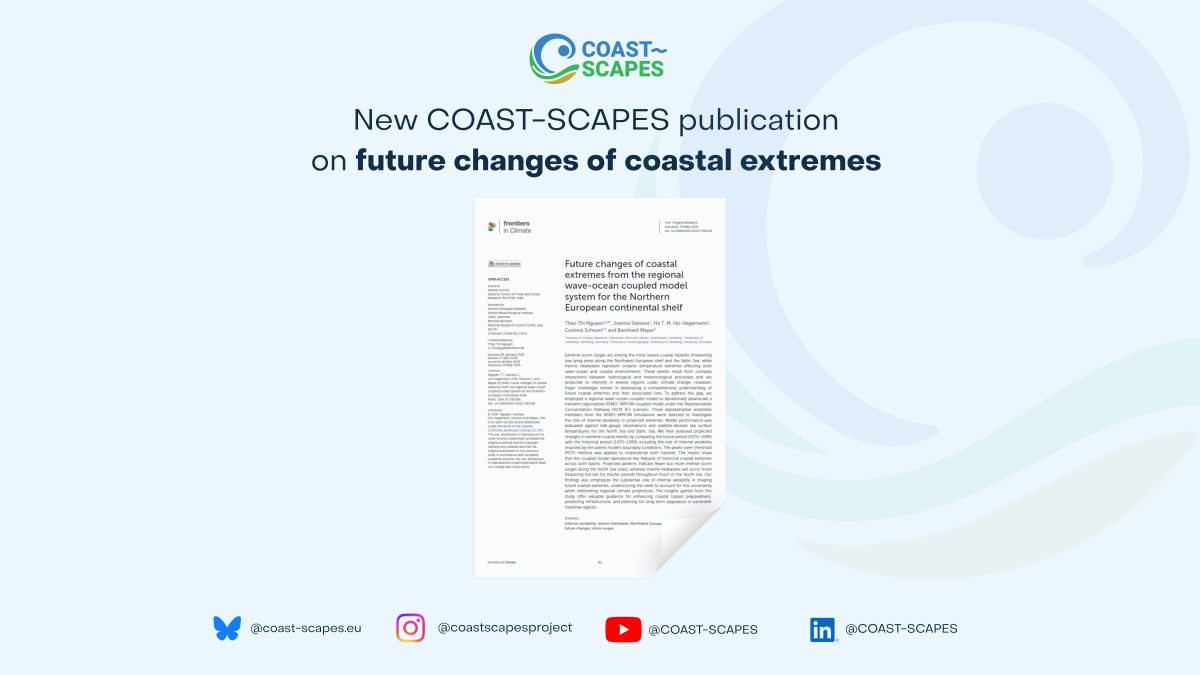
We are proud to announce the launch of a brand new scientific publication, supported by COAST-SCAPES itself, alongside two other Horizon Europe projects - SeaCLIM and FOCCUS. Titled “Future changes of coastal extremes from the regional wave-ocean coupled model system for the Northern European continental shelf,” the study can be openly accessed in the journal “Frontiers in Climate," collecting research that explores solutions that can help humanity mitigate and adapt to climate change, including topics such as mitigation, adaptation and policy for climate resilience and sustainable action.
While coastal hazards and marine heatwaves are often projected as the main threats in areas along the Northwest European shelf and the Baltic Sea, other major challenges remain underresearched, preventing the development of a comprehensive understanding of future coastal extremes and associated risks. This study employed a regional wave-ocean coupled model, downscaling the REMO-MPIOM coupled model, in efforts to explore the role of variability in regional climatic extremes. The experiment was evaluated against tide-gauge observations and satellite-derived sea surface temperatures from the North Sea and Baltic Sea, as well as in comparison to the future period (2070-2099) and the historical period (1970-1999). Across both basins, the results show that the coupled model reproduces key features of historical coastal extremes. The crucial role of internal variability is also highlighted in shaping future coastal extremes.
All in all, this study demonstrated COAST-SCAPES capacity to account for such uncertainties when interpreting climate projections, providing valuable guidance for improving coastal hazard preparedness, infrastructure protection and long-term adaptation across vulnerable regions and communities.


